
When it comes to mixing and blending in the cosmetic industry, two of the most commonly used tools are the homogenizer and the overhead stirrer. Both devices serve distinct purposes and are essential for different stages of product formulation. This article will explore the key differences between these two machines, their functionalities, and how to choose the right one based on your specific needs.
What is an Overhead Stirrer?
An overhead stirrer is comparable to a kitchen mixer or a blender. It operates by rotating a shaft with a mixing blade at high speeds, creating a vortex that blends ingredients together. This device is highly versatile and can handle a wide range of viscosities, from low to high. Overhead stirrers are ideal for tasks such as mixing shower gels, shampoos, and even emulsions. However, they do not break down particles into extremely small sizes, which is a limitation for certain formulations.
The primary advantage of an overhead stirrer is its simplicity and ease of use. It can run continuously for hours without overheating, making it suitable for large-scale production. However, for formulations that require a uniform emulsion with very small particle sizes, an overhead stirrer may not be sufficient. In such cases, a homogenizer is the better choice.
What is a Homogenizer?
A homogenizer, on the other hand, is designed to break down particles into much smaller sizes, creating a uniform emulsion. It uses a rotor-stator mechanism that generates intense shear forces, effectively reducing the size of oil or water droplets in the mixture. This process is crucial for creating stable emulsions in cosmetics, where uniformity and texture are critical.
Unlike an overhead stirrer, a homogenizer is typically used for short durations, usually 2-3 minutes, to achieve the desired particle size reduction. It is particularly useful for formulations that require a high degree of uniformity, such as creams, lotions, and serums. For those looking for advanced homogenization technology, a high pressure homogenizer offers even greater precision and efficiency in particle size reduction.
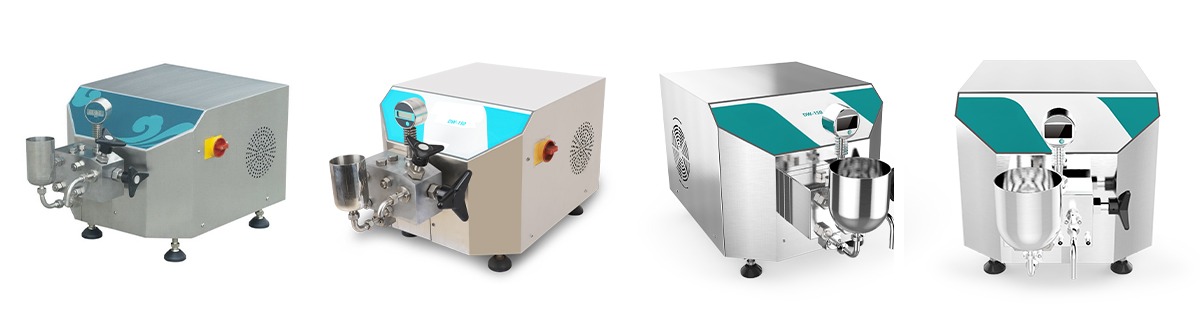
Key Differences Between Homogenizer and Overhead Stirrer
The fundamental difference between a homogenizer and an overhead stirrer lies in their mechanisms and the results they produce. While an overhead stirrer blends ingredients through rotational motion, a homogenizer uses shear forces to break down particles into smaller sizes. This makes the homogenizer more suitable for creating stable emulsions, whereas the overhead stirrer is better for general mixing tasks.
Another significant difference is the duration of use. An overhead stirrer can operate continuously for hours, making it ideal for large-scale production. In contrast, a homogenizer is typically used for short bursts of 2-3 minutes to achieve the desired particle size reduction. This makes the homogenizer more efficient for specific tasks but less versatile than an overhead stirrer.
Applications in Cosmetic Formulation
In the cosmetic industry, both homogenizers and overhead stirrers play crucial roles. An overhead stirrer is often used in the initial stages of formulation to mix raw materials and create a base mixture. It is also useful for blending low-viscosity products such as shampoos and shower gels. However, for formulations that require a high degree of uniformity and stability, such as creams and lotions, a homogenizer is indispensable.
For example, when formulating an emulsion, a homogenizer ensures that the oil and water phases are thoroughly mixed, creating a stable product with a smooth texture. This is particularly important for high-end cosmetics, where the quality of the product is paramount. For those seeking reliable equipment, Drawell Analytical offers a range of homogenizers and mixers designed for the cosmetic industry.
Practical Demonstration
In the video above, you can see a practical demonstration of how a homogenizer and an overhead stirrer work. The homogenizer effectively breaks down particles into smaller sizes, creating a uniform emulsion. In contrast, the overhead stirrer blends ingredients but does not achieve the same level of particle size reduction. This visual comparison highlights the differences between the two devices and their respective applications in cosmetic formulation.
Choosing the Right Equipment
When deciding between a homogenizer and an overhead stirrer, it is essential to consider your specific needs and requirements. If your primary goal is to create stable emulsions with uniform particle sizes, a homogenizer is the better choice. However, if you need a versatile device for general mixing tasks, an overhead stirrer may be more suitable.
For those just starting in cosmetic formulation, an overhead stirrer is often the more practical choice due to its versatility and ease of use. As your production needs grow and you require more precise control over particle size, you can invest in a homogenizer. Many manufacturers, including Drawell Analytical, offer both types of equipment to cater to different stages of production.
Both homogenizers and overhead stirrers are essential tools in the cosmetic industry, each serving distinct purposes. While an overhead stirrer is versatile and suitable for general mixing tasks, a homogenizer excels at creating stable emulsions with uniform particle sizes. Understanding the differences between these two devices will help you choose the right equipment for your formulation needs and ensure the quality and consistency of your products.